JAPANESE CAPITALISM. SELECTED CHAPTERS
Я. Шичихей
CONTRACT VERSUS CONSENSUS
In the last chapter, we discussed one misconception about Japanese society, the idea that it is consanguineous. Another common misconception is the belief that Japanese society lacks any basic conception of contract. In the discussion on this point, Komuro Naoki, the political scientist, commented incisively: this is simply not so, Japanese understand the concept of honoring a contract- The expression "A samurai never goes back on his word" is. a good demonstration. In the world of' Tokugawa merchants, do the same: one kept one's, promises. Japan is, moreover, one of the few nations that has settled all of its foreign debts. Treaties are a kind of contract. How could a country that strictly abides by many kinds of contracts be said to lack a conception of contract?
To say that Japan is not a contractual society means the contracts do not critically influence the social structure; к does not mean that individuals lack faith or that they do not abide by decisions reached through group consensus In Japan, the consensus system takes the place of contracts. which is why we are not identified as a contractual society Because the distinction between contractual and consensual societies is not always clear, let us examine a classic example of a contractual society. Semitic society, especially that of the strongly traditional Islamic peoples, offers an illustrative case.
Islamic Contracts
In an article interpreting the Khomeini revolution in Iran, entitled "God Booted the Shah Out," U.D. Khan Yousufzai, a Moslem, discusses the Moslem conception of contracts- Let me quote from the article:
To take the borrowing and lending of money as an example, let us say A borrows 100 yen from В and begins a business. If A's business shows a profit of 20 yen, then A pays В only 10 yen back- If he makes 300 yen, he pays В 150 yen. In other words, they share the profit equally. If, on the other hand, the business fails, A need not pay В back, with the understanding that should he later make a profit he will share it with B, This is the Islamic style of economics, k is based on a contract between man and God, closely resembling the concept of tsukiai (communal fellowship), which has existed in Japanese village communities since ancient times. Into this milieu, the Western concept of the contract—an agreement between two individuals—was introduced no more than a hundred years ago.
The similarity Yousufzai sees between contracts in the Islamic world and fellowship in Japanese villages is not altogether plausible, but the point is that the contract he is describing is one between God and man, not between individuals. Honoring a contract with another person is a natural consequence of honoring one's contract with God, And because both borrower and lender have made identical contracts with God, [he terms of their agreement need not be discussed.
If we study the effect of religious ideas in history, we find that the same was true in Western Europe. As Western society became more complex, so did the details of contracts, but ultimately both social systems can be traced back to the common heritage of Islam and Christianity, the Old Testament.
In the Islamic world, the content of the contract between the individual and God is of paramount importance. Second, there can be no contractual relationship between individuals who have not sealed identical contracts with God. Last but not least, because an atheist cannot conclude a contract, a Moslem cannot negotiate with him. The significance of this last point is frequently overlooked by Japanese visiting Islamic nations when they foolishly admit to being atheists-While I was talking with Yousufzai, he sighed, "I simply cannot see why our system is so hard for you Japanese to understand." A Japanese is likely to interpret a Moslem's attitude as either discriminatory or derogatory. But because the two systems are so different, such misunderstandings are bound to occur.
The Japanese custom of swearing before heaven, earth, and the deities (tenchi shinmei ni chikau) is quite different from entering into a contract with God. When Japanese make such a pledge, they swear to each other to abide by their agreement and merely call on heaven, earth, and the deities to act as witnesses or guarantors. Parties reach a consensus and then swear to each other with a god as their witness that they will keep their word- Consensus precedes everything. The Bible forbids this. Christians and Moslems conclude a contract with God, promising Him they will keep their word, and while one party makes his pledge, the other listens. The two patterns are illustrated in Figure 1.
Islamic Pattern
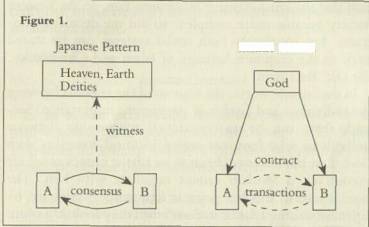
Extralegality of Consensus
Both of the above systems have their own rationality and irrationality. As long as they operate within their own cultures they function smoothly. But when one of the systems is introduced into another culture, problems understandably arise that involve all aspects of the society. Such problems arc now being encountered not only in Islamic nations but in Japan as well.
Japan's first experience of this sort came shortly after Christianity was introduced here in the sixteenth century. In a certain contemporary document is a concept that baffles Christians and Jews alike. Explaining it to Westerners is more difficult than explaining Islamic concepts of borrowing and lending and oaths based on a monotheistic religion to Japanese.
The document I speak of is called the Nanban seishi (The barbarian oath). There were at the time two oaths used by the authorities in their suppression of Christianity, one for non-Christians, by which they were made to swear they were not Christians, and another for Christians, by which they disavowed their religion. The latter was the Nanban seishi.
To lend credence to this oath. One needed a divine witness. But who? A Christian remained a Christian until the moment of his apostasy, and so he could not very well swear to heaven, earth, and deities in which he did not believe. The answer was simple. Christians were made to swear before the Christian god. Simply put, they swore to God that they did not believe in Him. Let me cite a passage.
I do hereby solemnly swear on pain of the divine punishment of our heavenly Father, Mary, and the myriad angels- [If I break my vow] let me be handed over lo the demons of Hell after my death. [here to suffer eternal torment. And while still in this world let my body be wracked by disease, and let me be called leper.
As curiously contradictory as this document is, it makes perfect sense within the Japanese context, where consensus is absolute. The Nanban seishi was preceded by an agreement between the inquisitors and the Christian. Having reached a consensus, they merely needed someone to act as witness.
If one party to an agreement believes in Shinto and the other in Buddhism, Japanese will not hesitate to call on the gods and buddhas, respectively. If one of the parties happens to be a Christian, he of course should call on God as his witness. Consensus is more important than the gods, buddhas, or Christian god in Japan.
Unilateral Action
The implications of this consensus system extend far beyond the confines of religion to touch the course of the nation itself. The Council of Three Army Chiefs, which I mentioned in the previous chapter, is a case in point.
By law—by contract, as it were—the three army chiefs reported directly to the emperor. Had Japan been a contractual society, their conferences could only have come about as a result of the terms of their contracts with the emperor. The relationship would have been like that of A and B, as described by Yousufzai. Instead, after discussing something among themselves and reaching a conclusion, they called on the gods in the form of the "living deity," the emperor, to act as guarantor. To their minds, by reaching a de facto decision without actually consulting the emperor, they were not disregarding divine authority, but rather demonstrating their faith in it. Nor did they consider themselves disloyal subjects; on the contrary, they believed themselves to be the most loyal Japanese in the nation.
The imperial army is now defunct, but Japanese functional groups remain communal, and consensus means more than law to them. But rather than calling on the emperor to make their decisions final and absolute, people now invoke the Constitution. In that the Constitution can be used to support decisions that arc really extralegal, the situation recalls the Nanban seishi; it is like swearing, with God as witness, that one docs not believe in Him. The same is true with many large Japanese corporations, as we shall see.
It is easy enough to criticize this system, but pointless really, because the same informal norms govern personal behavior. In fact, were one to try running an organization in Japan strictly according to contract, the same people who criticize the present system would attack the new one even more severely.
A Japanese Catholic priest once told me of the experiences of a French priest who came to Japan and was asked to assist in running a certain organization. He hired personnel strictly by contract, giving some three-year contracts and others five. Those who did not sign a contract had no job security and could be dismissed at any time. The contract was all that guaranteed their place within the organization. The priest assumed that those working without contracts understood this.
They did not. As far as they were concerned, their employment was based on mutual understanding and could not be terminated without establishing another understanding to that effect. Therefore, each time the priest had employees dismissed, they objected strongly. Although he explained that they had forfeited all rights when they agreed to work with no contract, in their minds he was guilty of the greatest of sins in a consensus society:
unilateral action. He encountered similar problems when an employee's contract expired. In his thinking an employee's rights expired along with his contract. But in Japan one signs a contract with the understanding that when its term expires, employer and employee negotiate a new one.
What's in a Contract?
In Japan, a contract might be said to contain only one provision of overriding importance: that in the event of disagreement, both parties will discuss the matter in good faith. If a contract is concluded at all, it is no more than a document affirming the tradition of dialogue- To ignore a country's traditions, like the well-meaning but ignorant French priest, is to invite a host of problems.
Likewise, we Japanese must adapt ourselves to contractual society when we do business abroad. A manager I know set up operations in the United States, drawing up a Japanese-style employment contract. First he put in a clause requiring mutual good faith, but found that it had no effect whatsoever on his American employees. Next he deleted the clause altogether, but without any penalty provisions for breach of contract he was helpless to enforce it. When he consulted an American lawyer, the man only laughed. Indeed, according to Western custom, the manager was in the wrong, not the employees who took advantage of the loopholes in [heir contracts.
In Japan, too, people occasionally make use of loopholes. A well-publicized example is that of the Yomiuri Giants baseball team, who exploited a loophole in the rules covering the drafting of players in order to sign up the promising young pitcher Egawa Suguru in 1978. The "Egawa Problem" was in the news for nearly three months, during which time opprobrium was heaped on both Egawa and the Giants.* According to Western thinking, however, responsibility for the affair rests with those who drew up the rules. As far as I know, the dramatist and critic Yamazaki Masakazu, who has spent a great deal of time in the United States, is the only Japanese to make this point.
Humans everywhere are fallible creatures, and inevitably they will draw up imperfect contracts. In the West, when loopholes are discovered, an effort is usually made to close them. The Japanese manager of whom I spoke, after failing twice, finally succeeded in drawing up an airtight contract. This is because he was in America, a contractual
*The scandal spawned a neologislic verb "egawaru." meaning to act selfishly and underhandedly. When grade-school children were asked to name the three things they liked the least, they replied, in order, Egawa. green peppers, and [he sumo Grand Champion Kitanoumi, whom many regarded as overconfident. [Trails. |
Society, and had no choice. This is not the case in Japan. In spite of the Egawa scandal, to my knowledge no one suggested that the rules covering the drafting of players be revised. The loophole remains, but there is little chance that anyone else will exploit it, for while we have contracts in Japan, it is not the contract that has binding force- It is extralegal, supracontractual societal norms that keep Japanese in line. To defy these rules is to invite society's wrath.
The Rewiring Door
Western contract-based organizations are, in fact, modeled on the Catholic church. I once gave a talk on the Society of Jesus before a group of Japanese businessmen. The Jesuit order was formed around Ignatius de Loyola in the fifteenth century, and its seven charter members signed an oath on Montmartre, on which they based the rules and organization of their group. When 1 said this, one of the men hi the audience remarked that the group's start resembled the founding of a corporation. I laughed and replied that it was the other way around: Corporations are patterned after this group. Puritan society was formed the same way, based on the Mayflower Compact.
Whether a religious order, a nation-state, or a company, all Western organizations have but one base: a contract in the form of an oath, a constitution, or a set of articles of incorporation. By this contract a religious order sets forth its rules, a state enacts laws, and a company establishes regulations, all stipulating the individual's rights and obligations- A more specific work manual is then drawn up, spelling out job assignments and procedures, A contract is a prerequisite for admission into the functional group. Without a contract no work can be done, for there will be no way of knowing one's position in the organization, what its rules are, or what one's rights, obligations, responsibilities, or limitations are.
Western workers would not think of joining a corporation without first drawing up a contract. Grounded in the contract, organizations like chain stores, whose yearly employee turnover is 250 percent, can function, A Japanese company simply could not: tolerate such a turnover. What makes the system work is the fact that the contract makes clear the terms of employment, and an employee need merely do what he has agreed to do. Naturally, he has no rights other than those granted in the contract, but then neither does he have any other obligations or responsibilities. The work for most employees in such organizations is simple in nature, and no matter how many years they put in, they do not rise; automatic promotion by seniority in such organizations is nonexistent. If a worker is chosen for a higher position, he receives a new contract describing his new duties along with his job limits, rights, obligations, and responsibilities.
Rules and Regulations
Whether superior or inferior to the Western system, the noncontractual Japanese employment system, like the seniority system discussed in chapter 1 has remained fundamentally the same from the Tokugawa period, through the Taisho era of small and medium industries, to the postwar era of large-scale industry. It is clearly not based on rules and regulations. Nevertheless, most Japanese companies have collections of company rules and regulations.
Komuro Naoki and I once visited a publisher that specializes in economics- During our conversation with the president, Komuro asked, half in jest, "Do you have company rules and regulations?" "Of course," was the president's prompt reply. "We published a volume called Collection of Rules and Regulations. So we have a fine set of bylaws for ourselves."
"Have you ever read it?"
"Are you kidding?" the president laughed.
Komuro looked around him. "Has anyone here read it?" he asked. Everyone in the room chuckled. "Then when you hire new personnel, how do you conclude a contract, and how do they learn what their obligations and responsibilities are?"
"When we hire someone, we just put them to work in the editorial or business office, and in four or five months they know how things are done,"
"Then why do you need rules and regulations?"
"Well. . ,"
Strange as it may seem, it is the same in all companies. From the president down, no one reads the company rules. When I asked the president of a securities firm about rules, he replied, "Certainly we have rules. We're authorized by the Ministry of Finance, you know. We have a formal set of rules and regulations." But when I asked if he had ever read them, he said no. More important, he said, was a set of five precepts that all employees recite every morning. It is less a collection of rules than a sort of family homily, embodying the basic moral principles of the communal group.
Rules do, however, have a very important function in Japanese organizations. They are used to preserve the traditional consensus system in much the same way as the gods are called on to guarantee the sincerity of the parties to an agreement.
I remember suggesting to a university professor one day the result of any contract. But a contract can produce a pseudo-parent-child relationship in a pseudo-consanguineous group. And because there are social norms covering the relations between parent and child, one need merely exchange a contract either on paper or verbally to the effect that a parent-child relationship exists. There is no need for setting down provisions in the contract. On this point, the Japanese "fellowship" resembles the Islamic contract. There, of course, religious law governs the individual's contract with God, so when A agrees to borrow money from B, there is no need for a detailed contract.
We often say that the Islamic world is a closed society or that it is inscrutable. To one unfamiliar with the unstated terms of contracts there, it will certainly seem incomprehensible. But as difficult as Islamic society might be for Japanese to comprehend, we can gain a certain amount of understanding through the Islamic law, sharia, the fundamental concepts of which are the same as those of Western law. What we Japanese do not realize is that Japan itself appears to outsiders even more closed and inscrutable.
While I was on my trip to the United States, I had an opportunity to talk with a State Department official in charge of Middle East affairs, and this topic came up. To sum up his words, problems concerning the Middle East are not easy to solve, but Americans believe they understand the countries involved. But: while there is no major problem between Japan and the United States (at the time), Americans do not really understand Japan.
In Japan, contracting individuals say, in effect, "Let's make a promise." "O.K." That is all it takes to establish a pseudo-parent-child or fraternal relationship. The moral code that governs this fictive relationship is an unwritten law, knowledge of which is acquired only through experience; nowhere has it been codified. For this reason, no one other than a Japanese can enter into this relationship.
Indeed, individual Japanese are open, flexible, and polite. Moreover, we make efforts to see things from the other's point of view. But open, our society is not. It is therefore virtually impossible for Japan to import workers to meet even the most severe of labor shortages. Foreign laborers would want to enter a functional group based on a contract, but as long as they did not join a pseudo-consanguineous group, they could not.
To exaggerate a bit, one might say that to work in Japan, one is asked, "Please join our group," and one responds, "Thanks. Please watch out for me." There is nothing more, nor is anything more needed- It is a provisionless blood contract, as if the parties had agreed that from that day on employer and employee were parent and child.
But just what sort of psychology underlies this social structure? And how does the interaction of the two turn the communal group into a functional one? I will take that up in the next chapter.
IV
ROOTS OF THE MODERN ETHOS
A people's value system is a continuum, and so the ultimate source of contemporary values lies shrouded somewhere in the mythological age. Still, there are limits to how far back one can look and still discern values that bear any resemblance to those of the present day. Values are a function of conditions, and conditions in ancient times were markedly different from today. To discover the source of contemporary Japanese values, we really need look no further than the Tokugawa, or Edo, period (1603-1868).
The Tokugawa period was a postwar era of sorts, preceded by almost three hundred years of social, economic, and political turmoil mat culminated in an unsuccessful attempt to invade Korea—a prelude, as it were, to our disastrous experience in World War II- With the establishment of the Tokugawa shogunate, me country entered a period of prosperity and order. Values suited to times of war naturally gave way to peacetime values.
Tokugawa Heritage
In many ways the Tokugawa period is the most interesting in Japan's history. During that time Japan developed a truly independent social system, one that remained largely unchanged for nearly three hundred years. It was not an age of imitation like the Meiji period, when we emulated the West, or like the postwar years, when America became our model. Nor was it like the classical period, when we patterned our culture after a Chinese model. In a sense it might be called our most original age, Tokugawa thinkers had to rely on their own resources, while politicians groped toward a new order by trial and error. The new system was built on the base of the indigenous value system and the social structure that supported it.
The Tokugawa period can be roughly divided in two, with 1710 as the rough line of demarcation. The first halt may be considered a continuation of the Momoyama period (1573-1603). Order was established, political and economic systems were set in place, and the country entered a period of rapid economic growth. In the latter half the system appears to stagnate, but, in fact, during this time education spread, popular culture developed, and the standard of living for the masses rose. The country seemed to be gathering energy for the plunge into the Meiji period. Not only did Tokugawa society have much in common with modern Japan; it is the base on which modern Japanese society was built.
It is usual to think of the Tokugawa period as characterized by the strict differentiation of the populace into the four classes of warrior, farmer, artisan, and merchant, but the distinction was not always clear-cut. In the case of Ishida Baigan (1685—1744), the focus of our attention in this chapter, his family was originally of the warrior class but they later became farmers. Though born a peasant, Baigan went into service as an apprentice in Kyoto, thereby becoming a member of the merchant class. This was a common practice for the second and third sons of peasant families- Upward mobility was possible too; some bought their way into the warrior class. The fact that social mobility was possible indicates that all classes shared certain norms-
The social order and system of values that took shape in the Tokugawa period are prototypes of Japan's modern pseudo-consanguineous system, described in the previous chapter. In Tokugawa society, loyalty and filial piety were really one and the same; the consanigumeons principle of filial piety was extended to cover' all institutions. But before this was possible, a pseudo-consanguineous system had to have been established and functioning like the real thing, bringing nonconsangumeous groups together as if they were blood-related, creating fictive, main family-branch family relationships. Moreover, people had to have accepted the pseudo-consanguineous principle. (Only with this Tokugawa heritage could! modern companies, their primary and secondary subsidiaries, be ded together in a familial relationship in the absence of blood ties or contracts.)
Ishida Baigan
Ishida Baigan is a representative figure from the latter half of the Tokugawa period who exerted great influence on the development of the value system that grew up in response to the new social structure. He is remembered today as the founder of the influential Ishida school of popular ethics (Sekimon Shingaku). Most of his career was spent as a diligent employee, not unlike his modern counterparts. It is primarily in his latter role that we will study Baigan. Owning to bad luck and the nature of his times, rather than lack of ability or flaws in his character, Baigan was never a very successful wage-earner. On this point, too, he resembles many modern salaried workers.
Baigan's life is described in Ishida sensei jiseki (The achievement of Master Ishida), the work of a disciple. He was born in 1685 in a mountain hamlet located about ten kilometers south of Kameoka station on the San'in Line. Now part of Kameoka city, Kyoto prefecture, it was called Toge village in his day. Today it seems an out-of-the-way place, but because walking was the usual mode of transportation in the Tokugawa period, the village was in fact convenient to both Osaka and Kyoto.
Baigan's family was what we would call today a typical middle-class farming family. Situated in the mountains, their village had little land for cultivation. Its inhabitants eked out an existence mainly by farming and lumbering. Although Baigan's family was part of the Ishida clan, which had founded the village, life was never easy. He had an older brother and a younger sister, and there, too, his was a typical family. Being the second-born son, he had a relatively unpressured childhood. Moreover, he appears to have been an average boy in most respects; there are no episodes that presaged his genius, nor is there any record of his having had an education for precocious children.
Originally, the Ishida clan were minor local lords who held three villages in the area, but as a result of a political struggle, they lost their claim to their holdings and were reduced to working the land- This occurred a hundred years before Baigan's birth. Although his family was regarded as a branch of the Ishida clan, in reality they were clan retainers and had no blood ties with the main family. In a system prevalent at the time, known as kabuuchi, they were conferred honorary membership in the Ishida clan and were allowed to use its name as a reward for years of faithful service. The clan was a good example of a pseudo-consanguineous group centered on me main house.
The kabuuchi system survives today in the form of the corporate stock-sharing plan. Just as loyal retainers in Baigan's day were rewarded with honorary membership in the clan they served, so employees today are given shares of company stock, which heightens the workers' sense of membership in the collective group and promotes a strong sense of loyalty. This arrangement, of course, contrasts sharply with stockholding in a contractual society. There, whether one holds stock in one's own company or in another, it is an investment and nothing more.
Mountain Chestnuts
An anecdote recounted in Ishida sensei jiseki is of some interest:, for it sheds light on Baigan's character, as well as the norms under which he and other Japanese lived.
One morning when Baigan was ten he went off to play in the mountains near his home. When he returned at lunchtime he showed his father five or six chestnuts he had picked up. His father asked him where he had found them, and Baigan replied that they had been lying on the boundary line between their own and their neighbor's mountain. In that case, said his father, they must belong to the neighbor, for none of their chestnut trees overhung the boundary line- Though Baigan had not yet finished his lunch, his father ordered him to go right away and put the chestnuts back where he had found them. Baigan did as he was told- Later in life he is said to have remarked, "I didn't really want to take the chestnuts back; it seemed a waste. At first I resented my father. I realize now it was for my own good."
Baigan's father was by no means atypical ofTokugawa peasants. As [his episode shows, he perhaps had a clear idea of ownership, and the agricultural community's rules governing interpersonal relations were very strict in those days. Such was the society into which Baigan was born.
At the age of eleven, Baigan was sent to Kyoto as an apprentice (detchi). Apprentices were provided with food, clothing, and shelter, but received no wages. Sometimes they had to have rice sent from home, a custom thac survived into this century. In many ways his apprentice period was similar to the time young workers now spend in company schools. Like students doing part-rime work while tlu'y study, the apprentices did odd jobs and assisted the shop master, and in [he process they acquired business and technical skills. It was an advantageous arrangement for both master and apprentice.
Workers generally became apprentices between the ages of eleven and fourteen. In so doing they became apprentice adults; though expected to behave like adults, they were not burdened with adult responsibilities. After several years of learning the trade, an apprentice became a worker and advanced to the rank ofledai, then yadoiri, and finally he established his own business or a subsidiary.
Unfortunately for Baigan, his career did not go so smoothly. Though once a man of means, his employer began to have business troubles at about the time Baigan went co work for him. Apprentices customarily received livery twice a year—at Don and New Year—but Baigan's employer was unable even to provide these- When Baigan returned to his parents' home for a visit wearing the same clothes he had worn when he left four or five years earlier, Baigan's mother was understandibly surprised. She asked him why, but he would not give her a straight answer. This was probably the reason why the friend of Baigan's father who had arranged the job in Kyoto later paid a call on the shop. Realizing that the company was on the verge of bankruptcy, he explained the situation to Baigan's father. He apologized profusely, and recommended that Baigan look for a more suitable place to work. Baigan's father, however, decided to have the boy return home.
When he finally returned, Baigan's mother asked him why he had tolerated such conditions without a word of complaint. She felt sorry for her serious son, and probably believed that had he mentioned the problem when he was home before, they might have been able to help. But when Baigan left home, he had been told to think of his master as both father and employer and to serve him faithfully, and this he had done. When you think of someone as your father, he is said to have replied, you don't go telling outsiders about his faults. It is not clear what his parents said in response to this but they probably had no answer. Today, too, sometimes a company employee commits suicide to protect company secrets; Baigan's loyalty was no less than that.
Baigan was raised in a village that was part of a pseudo-consanguineous clan centered on the Ishida family, and he himself was a member of the clan community. When he went into service in Kyoto, it was under a similar pseudo-consanguineous arrangement. The moment Baigan entered the company community of his employer, he automatically ceased to be a member of his clan community. Thus it was easy for him to think of his employer as his father.
Boom and Bust
The Tokugawa clan's victory over die Toyotomi clan m 1603 brought nearly three hundred years of civil war to a dose. The first hundred years of the Tokugawa period were really postwar years, because they were a period of recovery. As in the twenty-five years after World War II, when many small and medium-sized enterprises throughout the country grew into large industries almost overnight, the Japanese economy grew very rapidly during the early Tokugawa period.
The feudalistic system founded by the Tokugawas established the above-mentioned four classes, clearly dividing society by occupation. Though formally ac the bottom of the social ladder, the merchant class was by far the most vigorous, leading the populist educator Honda Toshiaki (1744-1821) to comment, "To all outward appearances this country is ruled by the warrior class, but, in reality, it is ruled by merchants." The author of Seken kenbunroku (A record of worldly happenings) notes, "More than anyone else, merchants are free to make profits, indulge their desires, and work as they please. Unaffected by wind, water, or drought, exempted from the land tax and public service, they enjoy more freedom than any other class." Indeed, the freedom of warriors was restricted by the lord-vassal relationship; that of farmers by dependence on the land, submission to the feudalistic system, and vulnerability to the vagaries of the weather; and that of artisans by the level of their craft and skill. But a merchant's potential for making profits, indulging his desires, and working as he pleased in free competition with others was limited only by his ability.
Every merchant belonged to a collective body whos<-function was the pursuit of commerce. To say that merchants were free to work as they pleased is to say that those who worked hardest were the most prosperous. One's fate was intertwined with that of one's business. To survivi-amid the keen competition of the time, a business had to be a functional unit, and to function effectively its members had to possess prodigious diligence and self-control.
By Baigan's generation, however, the economic boom was over. No longer did workers uniformly move up the seniority ladder, guaranteed eventually to be established on their own, as retired workers of modern times are given positions in subsidiaries- In many ways the economic situation resembled that of today, when growth has come to a standstill.
They were bad economic times when Baigan, at the age of twenty-three, once more went into service in Kyoto, probably for a dry-goods dealer named Kuroyanagi. Although he could not have counted on smooth advancement through the seniority system, if Baigan had entered the company in his teens as an apprentice he would at least have had a chance for promotion. But by entering ten years late, he found himself outside the seniority system altogether. Because the average lifespan in those days was fifty years, and workers commonly retired at forty-five, his experience was comparable to entering a company at thirty-five today.
It is apparent from Baigan's writings and from anecdotes about him that he was an extemely honest, ingenuous person. He once described himself as a "creature of logic." His own description seems most apt, as is apparent from his work Tbhi mondo (Town and country: questions and answers). As the title suggests, it is written in ques-tion-and-answer form; Baigan is supposedly responding to questions asked by someone else, but more likely the question-answer form is his own invention, by which he hoped to refute or revise statements he had made himself. At one point the questioner asks Baigan his opinion of the story of creation as recorded in the Kojiki and Nihon shoki, Japan's oldest surviving prose works, asserting that it must be a fabrication. If man had been created after the formation of heaven and earth, the questioner argues, there would have been no one present to witness the event. Baigan agrees. Baigan's determination to think things through logically is striking. I know of no one, even as late as the World War II years, who declared the story of Japan's creation to be a myth using a similar logic,
His strict self-control and habit of subjecting everything to methodical reasoning made Baigan somewhat inflexible, yet extremely reliable, as an employee. Though he realized he was trapped in a dead-end job, he refused to indulge himself in dissipation or amusement. As a result, he soon displayed symptoms of neurosis and his work began to suffer.
Worried about Baigan, the mother of his employer and the shop's head clerk suggested that he visit the gay quarters. Today one would be told to go to a cabaret. Baigan considered their words: If he did as they suggested, his employer would have to bear the expense; this was not right. Yet the alternative was to continue as he was, taking medicine day and night, for which his employer was also paying. At last he decided char it was in his employer's best interests for him to visit the pleasure district. For a time Baigan gave himself to dissipation-But it was noc a long-term solution. He soon recovered from his depression and could no longer claim that his dissipation was for his employer's sake; plainly it was for his own pleasure. This amounted to stealing from the man. When he realized this, he felt worse than before. He immediately explained the situation to his employer, sold some of his clothing and his short sword, and paid him back. His is the kind of story one would like to share with the many Japanese executives today who are dubbed shaydzoku (the expense account tribe).
To what can we attribute Baigan's manner of thinking? Undeniably his character, his childhood education, and his immediate environment were contributing factors. An especially important influence was the age in which he grew up, an age of enlightenment, when knowledge was made available to the masses through books known as kanazoshi. Clearly the enlightenment atmosphere did much to stimulate the logical, intellectually curious Baigan. Kanazoshi is a broad genre—so broad that the term "genre" is misleading. It embraces everything from adult comic books to enlightenment and didactic works. Many resemble modern "how to" books, offering practical advice on tea ceremony, flower arranging, cooking, etiquette, ballad singing, and the like- Others present fascinating discussions of Confucianism and Buddhism. Today these works would be touted as "upholding the highest standards of scholarship, yet easily understood by the layman."
Baigan was a compulsive reader. While serving his master as both clerk and salesman, it is said that he was never without a book. He read in the middle of a sale, he got up early to read before work, and he read late into the night. It is not clear what kind of books he read, but judging from the erudition of his later writings, despite the lack of formal education, it seems safe to conclude that his reading ranged over the entire kanazoshi genre. In a word, he internalized the plebeian intellectual milieu in which he lived.
One need not search for the source of Baigan's thinking; his thoughts were his own. More than anything else, he was a clerk in a store, not a representative of some school of thought. If we had to describe Baigan in his later years, we would probably say he was a sort of townsman-Confucian, what might today be called a social commentator, and nothing more—certainly not a bona fide scholar with the appropriate credentials. He continued to study for his entire life, and his reading was by no means confined to kanazoshi, but the basis of his thinking throughout his life remained plebeian and wholly his own.
Like all writing of the day, Baigan's works are studded with quotations from Shinto, Confucian, and Buddhist sources. Sometimes they are offered as the wisdom of the sages. In most cases, however, quotations are used arbitrarily, not necessarily as their authors intended. Baigan would ignore the context of the passage he quoted, bor-ics literal meaning to advance his own argument.
The original framework of ideas was broken up and individual ideas incorporated piecemeal into an intellectual matrix of his own creation. Therefore, whatever the source, and however long the quotation, each must be regarded as the thought of Baigan.
Being a merchant, Baigan was thoroughly rational. To function as such, one needed to be rational where money was concerned, rational by nature. Rationality is in highest demand in times of economic stagnation, rather than during an economic boom. Until the 1970s, when we were disabused of the myth of unlimited economic growth potential and we abandoned our grandiose plan to "remodel the Japanese archipelago," we believed that any enterprise would succeed. The same was true of the early Tokugawa period. But about the time of the shogun Yosh-imune's reforms in the Kyoho period, the illusion was shattered.
The Kyoho reforms centered on the shogunate and the warrior class. Civil administration, as practiced from the time of Tsunayoshi and leharu, was discredited, and instead the government encouraged simplicity and frugality, prohibited extravagance, and promoted the martial arts. It also attempted to promote industry, but this went no further than physiocracy, which mainly benefited the warrior class.
One result was stagnation in the economy, business, and industry, but it also gave rise to the argument that merchants are unnecessary, which resembles the thinking among some today that general trading houses (sogo shosha) are basically evil. Actually human thinking changes little over the ages. When business prospers, merchants are valued, but when times are bad they are often made out to be more corrupt than the politicians, who siphon off their meager profits.
This atmosphere led Baigan to comment, "People accuse only the merchants for being greedy and unprincipled, caring only for profit. People resent their activities and would like to curtail them. why are merchants singled out? If one looks at the rabidly antimerchants writings of Ogyu Sorai, itself, but that through study he hoped to profit from the wisdom of the sages and thus discover the ideal state for man. He sought to become this sort of man himself and to be a model for others, he said. Throughout his life, Baigan disliked those who prided themselves on their learning, contemptuously referring to them as moji geisha (learned geisha). No doubt he sensed a danger in the argument that merchants served no purpose, and he was wary of merchants' irrationality, which was partly to blame for the sentiment against them at the time. Thus he said, "Though I may be wandering about the town ringing a bell that no one can hear, I must try to show them the Way." In order to find "the Way" and to pass the wisdom on to mankind, Baigan avidly read and lived according to a strict code of personal behavior.
Though Baigan was highly individualistic, he did not live in a vacuum. Like all thinkers, he was heir to an intellectual heritage. To whom, then, was he most indebted? It seems that at about thirty-five Baigan believed he understood the proper way for man to live, but that the realization unnerved him. For six months to a year he sought teaching from a number of Confucianists, but was unable to pick up anything useful.
At about this time, he met Oguri Ryoun and became his pupil. Concerning Ryoun, we know only that he was originally of the warrior class and that he studied Zen. Under Ryoun, Baigan seems to have undergone an intellectual awakening when he was told, "Man is by nature indiscriminate." Because a kanazoshi of unknown authorship called Menashigusa (Indiscriminate grass) was popular at the time, it is surmised that it strongly influenced. Baigan.
However, part of Menashigusa is titled "Ninin bikuni" (Two nuns), the same as a work by Suzuki Shosan, whom we will discuss in the next chapter. It is thought possible that the volume is Shosan's creation or that he wrote it based on another, probably earlier, work. It would seem, therefore, either that Baigan was the inheritor of the ideas of Shosan or that both men are indebted to the same source- In either case, they were very close in their thinking, as was noted by one of Baigan's disciples in his preface to a work by Shosan.
Ryoun died in 1729 at the age of sixty- Apparently, Baigan was his most trusted disciple and logical successor, for just before his death he told Baigan that he could have all the works he had annotated. Receiving one's teacher's library is considered a great honor even today, but in the Tokugawa period, when the secret teachings of masters were valued above all else, it meant no less than that Baigan had been chosen to succeed Ryoun. Baigan, however, curtly replied that he did not want the library. When Ryoun asked why, he said that he was certain to put his own interpretation to the works. Ryoun was reportedly delighted with his response. Indeed, it seems very much in character. For while Baigan read widely and was devoted to Ryoun, he remained strongly individualistic and supremely self-confident. Above all else, he wanted to think for himself and to give expression to his own ideas.
After Ryoun's death, Baigan quit his job and opened a small, private school. This was the start of what came to be known throughout Japan as Sekimon Shingaku, which was to have a profound influence in Japan.
Basis for Capitalism
Had Baigan been a salaried worker in Japan today, he would have been a splendid one. In any advanced nation, a person like Baigan would be considered a dependable businessman. An especially significant aspect of Baigan's thinking is his starkly clear conception of private ownership. Without a clear conception of private ownership, capitalism could not have developed in Japan. As we have seen, the concept existed in rural villages at the time, but Baigan developed it further. Many years after he paid his employer back for the money he spent in the gay quarters, Baigan wrote, "What is mine is mine, what is not is not. I intend to be repaid all I have lent others and to pay back all that I have borrowed. This goes for everything—even a strand of hair. There is no other way to live honestly."
Not all nations understand the idea of private ownership. As the Kremlinologist Shimizu Hayao points out, this concept is lacking in the Soviet Union. When Russians have something, they share it among themselves. When they are without, they think nothing of stealing from others. Needless to say, differing conceptions of ownership can lead to serious misunderstandings.
What made possible the appearance of someone like Baigan? In the age of warring states, the average citizen did not think as he did. The age as it is portrayed in medieval literature is totally different from the world of Baigan. People then showed none of Baigan's self-restraint. Robbery was a part of everyday life. But in the early Tokugawa period, norms underwent a sudden and dramatic change. Not everyone in the Tokugawa period shared the intensity of Baigan's sense of right and wrong, but it is clear that his were essentially the norms of the time. This is the age that produced Japanese whom we can finally recognize as resembling Japanese of today.
No matter how much wealth a nation might accumulate, how much oil it might possess, it cannot modernize without undergoing the same degree of change in societal norms. Once the change has occurred, even if it is bereft of all wealth and natural resources and forced to start from scratch, like Japan after World War II, a nation can modernize. But what triggered this crucial change? It was not the Protestant ethic or a mercantile morality based on it. In the next chapter we will explore what it was that set the stage for Ishida Baigan's appearance and propelled Japan along the road to modernization.
V
ZEN AND THE E-CONOMIC ANIMAL
The effect of a man's thought on later generations, especially when it is progressive or highly original is rarely what he expects it will be. Were Jesus to -visit the Vatican today and see the mammoth institution that has grown from the seeds of his teaching, he might well disavow it. If Karl Marx could inspect the "Gullag Archipelago" and if he were told that its facilities are the product of his thinking, he would not hesitate to separate himself from it entirely. The same is true of religious reformers. If John Calvin were shown America's capitalistic society and told that it is the fruit of the Protestanit ethic, he would probably be rendered speechless. A thought system functions in a variety of ways at a certain time within" a given social context, but society itself does not change in exact conformity with the directions of tinat though- yet among the thinker's original ideas, one - can often identify the seeds of later social change.
In this chapter we will examine - the thinking the man whom I see as most directly responsible for the development of capitalism in Japan, Suazuki Shosan. No doubt Shosan also would be dumbfounded to hear himself labeled the father of Japanese capitalism, certainly, he did not foresee present-day Japanese society, or even the flourishing merchant culture of the Genroku through the Kyoho periods (1688-1735). Had someone explained to that staid Zen monk the effect his thought would have on Japanese society, surely he would have been appalled. Some of his followers today might take exception as well.
Unique Zen Philosopher
In the circumstances of his life and in his character, Suzuki Shosan differed greatly from Ishida Baigan, whose youth and career were discussed in the last chapter, and whose philosophy will be taken up in the next. Shosan's lifetime spanned the close of the turbulent Sengoku period and the era of the fourth Tokugawa shogun, letsuna (r. 1651-80). The changes that occurred in his life mirrored the times.
A samurai from Mikawa (present-day Aichi prefecture), Shosan was a retainer of Tbkugawa leyasu, and he took part in the fighting that brought nearly three centuries of civil war to a close and led to the establishment: of the Tokugawa shogunate. After peace was restored, Shosan worked for a time as a shogunate official in Osaka. Then, in 1620, for reasons known only to himself, he suddenly took the tonsure. He was aware that his action violated shogunate law and that the authorities might expropriate his entire assets and discontinue the family line, ordering him to commit ritual suicide. Fortunately they did not, and Shosan lived to the ripe old age of seventy-seven as a Zen monk, and a most extraordinary one at that.
Interestingly, the times in which Shosan lived resembled the era of Baigan in one important respect: a large segment of the population had lost sight of their reason for living.
Just as society m Baigan's day struggled to adapt to a stagnant economy after years of prosperity, society in Shosan's day had to adjust to peace after years of civil war. Certainly many people welcomed peace; even samurai, to some extent, had had enough of civil disorder, but the establishment of a peaceful social order deprived the warrior of his raison d'etre. Gone were the days when a peasant might rise to the foremost position of power through his martial exploits, as Toyocomi Hideyoshi had done. After the third shogun, lemhsu, it was clear that a coup d'etat against the shogunate was out of the question. Many samurai remained thwarted, feeling useless. It may be that a sense of frustration prompted Shosan to become a priest- How to resolve the contradiction—to find a reason for living in a new social environment—was the challenge Shosan and others of his generation faced.
The biggest problem one encounters when dealing with a Japanese thinker is the lack of systematization of his ideas. Christianity has a systematic, organized theology, enabling one to consider the interrelation of religion and society within the theme of Christian social ethics. But in the case of Zen, there is no such systematic "theology," or body of religious thought. Organization is anathema to Zen.
Strangely enough, we find in the writings of Shosan something like a systematic Zen "theology," as well as a corresponding Zen social ethic. Shosan once remarked, "I would like to see the world governed by Buddhist laws." Though he took Buddhist orders, he by no means abandoned the world, but remained keenly interested in politics and society throughout his life. On this point alone we must surely call him a unique Zen thinker.
Perhaps the reason for the systematic approach in Shosan's thinking is the fact that he was an anti-Christian ideologue, which is clear from his work Hakirishifan (Debunking the Christian myth), partly a Zen rebuttal to Christian teachings. To challenge another philosophical system, there is no choice but to turn the logic in it against itself. To do this you must arrange your own argument in contraposition to the other.
In most cultures philosophies take shape in a dialectical process of this kind, but in Japan's case there have been few opportunities for polemics and debate. This goes for the modern period as well, for imitation, our modern forte, docs not admit debate. One result is that Japanese have lost their powers of self-expression, the ability to communicate not only with the outside world but among themselves as well. For this reason they do not understand themselves.
The Buddhist Trinity
In Hakirishitan, Shosan defines the essence of the cosmos as the Buddha. This Buddha-nature cannot be seen or perceived, but it possesses three "virtues" that affect mankind, thus attesting to its existence. The three virtues he calls the Moon, the Heart, and the Great Healing King, by which he refers to three aspects of the Buddha, not three separate buddhas. His conceptualization clearly corresponds to Trinitarianism.
The Moon stands for the cosmos, the natural order. In the same way that a reflection of the moon's essence dwells within a drop of water, the Moon, the natural order, resides within every person's heart. This is the virtue of the Heart. Because humans are a part of the cosmos, their nature conforms to the cosmic order, and they need merely do as the heart commands. Naturally the concept of a holistic order is not Shosan's alone; it is found in medieval Christian thought and in the doctrines of Chu-tzu. It is one of the fundamental ideas in the intellectual history of mankind.
If every man has a Buddha-nature, there should be no war, no crime, no injustice; all people should behave like a Buddha. Why, then, did Japan suffer through nearly three hundred years of civil war? This is a question that preoccupied all Japanese thinkers of Shosan's day. In Shosan's opinion, the mind, like the body, fell victim to disease. All grief, he believed, was caused by three "poisons": greed, anger, and discontent. The mind's illnesses could be treated by the Great Healing King; to beg for a cure was to demonstrate one's faith. And if all people were cured and lived in accordance with the dictates of the Heart, there would be no more war and all social problems would disappear. They would live together harmoniously, each as a living Buddha, in a Utopian society.
In Shosan's view, to build a good society the heart of man first had to be protected from the three poisons. This required one to "become a Buddha," by which he meant to live in accordance with the dictates of the Heart. One had to engage in ascetic exercise, that is, Buddhist practice, to live this way, but how? Unlike priests, who were free to spend their days in ascetic practice, the average person had to work hard and steadily just to earn a living. How could they be saved? Shosan's answer: Everyday labor was Buddhist practice if performed with the right intention. With this conception as a base, he formulated what must be called a Zen social ethic, a concrete guide to how man should live. As such, its effect reached far beyond the sphere of religion to affect the whole of secular society.
Shosan presents his social ethic in Shimin nichiyo (Daily life for the four classes). Like Baigan's Tohi mondo, it is written in question-and-answer form- Representatives of each class—samurai, farmer, artisan, and merchant—ask Shosan how they should live, and he explains. Shimin nichiyo was later combined with Sanbo tokuyo (The three precious virtues) to form the work entitled Banmin lokuyo (Virtues of all), which Shosan's disciple Keichu called his most important tract. It is possible that Shosan became a monk so that he could spread the teachings embodied in this work. Because I believe Shimin nichiyo is the key to understanding Shosan's philosophy, let us briefly examine its content.
In the section on farmers, a peasant asks, "We are taught that the next life (life after death) is important and that we should not spare ourselves in Buddhist practice, but farm work keeps us so busy we do not have any time for practice. How unfair it seems that simply because we must make a living through menial labor, we are destined to waste this life and suffer in the next. How can we attain Buddhahood?" Shosan's answer is admirably clear: agricultural labor is Buddhist practice. It is a mistake, he says, to take time out from one's labor to pray for rebirth in Paradise. Agricultural labor itself is ascetic exercise.
You must toil in extremes of heat and cold, spade, hoe, and sickle in hand. Your mind and body overgrown with the [hicket of desire is your enemy. Torture yourself—plow, reap—work with all your heart, , - . When one is unoccupied, the thicket of desire grows, but when one toils, subjecting one's mind and body to pain, one's heart is at peace. In this way one is engaged in Buddhist practice all the time. Why should a peasant long for another road to Buddhahood?
A peasant who followed Shosan's advice was far more exalted than the most virtuous of priests, since priests did almost no work at alt- It was a question of the frame of mind in which one worked, not the kind of work one did.
If a farmer treats his work as asceticism, not only will he achieve Buddhahood but society wilt be purified. Shosan explains it like this: your birth as a farmer is Heaven's gift to the world, your mission being to nurture the world's people. Therefore, give yourself wholeheartedly to the way of Heaven with no thought for yourself. Serve Heaven through your farm labors. Celebrate the gods and Buddhas by raising the five grains, and save the people. Make a solemn vow to administer even to insects. Chant namu Amida bulsu with each stroke of your hoe. Work earnestly, and with each stroke of your sickle your fields will be purified. The five grains will then become pure food that will wock as medicine to extinguish the desires of those who eat it.
In Shosan's thinking, to work with all one's heart led to enlightenment and to freedom from all earthly constraints, making one a living Buddha. Work itself was ascetic practice. This concept forms the basis of Shosan's social ethic.
Japanese Religiosity
Next an artisan poses the following question. "I am busy every minute of the day in an effort to earn my livelihood. How can I become a Buddha?" Shosan answers:
All occupations are Buddhist practice; through work we are able to attain Buddhahood. There is no calling that is nut Buddhist, All is for the good of the world. . . . The all-encompassing Buddha-nature manifest in us all works for the world's good:
without artisans, such as the blacksmith, there would be no tools;
without officials there would be no order in the world;
without farmers there would be no food;
without merchants we would suffer inconvenience.
All the other occupations as well are for the good of the world. . . . All reveal the blessing of the Buddha-Those who are ignorant of the blessing of our Buddha-nature. who do not value themselves and their innate Buddha-nature and fall into evil ways of Chinking and behaving, have lost their way.
Because all human beings possess a Buddha-nature, to become Buddhas, above all you must believe in yourself. If you truly desire to become a Buddha, just believe in yourself. Believing in yourself is believing in the Buddha, for the Buddha is in you. The Buddha has no desires, its heart contains no anger, no discontent, no life or death ... no right or wrong ... no passions ... no evil . . .
Finally he says, "Believe with all your heart. Believe." Faith to Shosan was faith in oneself; there is no absolute, monotheistic god in Shosan's conception. Yet his exhortation to believe in oneself was not, of course, a defense of vanity.
An understanding of Shosan's approach to religion gives us valuable insight into modern Japanese society. It is commonly asserted that the Japanese are not a religious people, but this is shockingly untrue. Only the nature of our faith differs from that of Christians or Moslems- In Japan it is the Buddha of [he Heart rather than God in whom one believes and to whom one is held accountable for one's actions. A Japanese can say he has lost faith in God, and society will pay little attention, but let him say he has lost faith in himself and he will find that he has lost his credentials as a member of society, just as an apostate Christian or Moslem would elsewhere. In either case society is understandably suspicious of one who believes that one cannot be held accountable for one's actions.
Japanese themselves are guilty of perpetuating the myth that they arc not religious. From the middle of the Tokugawa period, Confucian influence strongly colored the daily vocabulary. Then in the early Meiji period there arose an anti-Buddhist movement, which led the government to order all Buddhist expressions deleted from the state-controlled textbooks. For this reason Japanese no longer appreciate the religious meaning of the words they use. Expressions people use all the time, such as "I must have been out of my mind" (Jibuti ga shitijirarenai, lit., "I cannot believe myself") or "To be honest with you" (Honshin dewa, lit., "In my heart of hearts"), are actually expressions of religious ideas. Because Japanese are not aware of the religious implications of the words they use, they do not see how deeply religion is still a part of their life and thought.
Pilgrim's Progress
The next section of Shimin nichiyo describes how merchants ought to live. In countries everywhere, merchants tend to be regarded with condescension or disfavor. In Tokugawa Japan, this tendency was especially strong, particularly among samurai. Shosan, however, does not show the least contempt for commerce or the merchants who practice it-In Shosan's view, "Commerce is the function Heaven has assigned to those whose job it is to promote freedom throughout the country." Today we use the word "freedom" in a variety of ways, tending to forget that one basic freedom is the free access to goods. Without the distribution of goods through commerce our freedom would be impaired in countless ways. Far from holding merchants in contempt, Shosan valued them for the vital function they perform. Considering the time in which he lived and his samurai origins, Shosan's enlightened thinking was unusual indeed-
While Shosan considers commerce, like all occupations, to be a godly activity, he does nut value commerce in itself as much as the way it is performed—whether or not it is performed as Buddhist practice. A merchant asks, "I ceaselessly pursue my humble trade in hopes of realizing a profit, but to my great regret I will never be able to achieve Buddhahood. Please tell me the way." In his answer, Shosan would by no means deny the merchant his profit, but he would urge him first to cultivate through asceticism the sort of attitude that will bring about profits: an un-bendable commitment to honesty.
Honesty is an essential element in Shosan's philosophy. If as a merchant you realize that your job is to bring freedom to the nation and unfailingly "pursue your calling with honesty, just as fire burns and water flows downhill, so the blessings of Heaven will follow and your every wish will be fulfilled." Yet one must not delight in realizing a profit. Such behavior Shosan calls "illusory goodness." To be content only after taking a profit encourages vanity and is sure to lead one into evil ways. Real goodness is non-illusory; one must engage in commerce with no illusions.
Shosan provides the following concrete advice for merchants:
Throw yourself headlong into worldly activity. For the sake of [he nation and its citizens, send the goods of your province to other provinces, and bring the products of other provinces into your own. Travel around the country to distant parts to brine people what they desire. Your activity is an ascetic exercise that will cleanse you of all impurities. Challenge your mind and body by crossing mountain ranges. Purify your heart by fording rivers. When your ship sets sail on [he boundless sea, lose yourself in prayer to the Buddha. If you understand that this life is but a trip through an evanescent world, and if you cast aside ail attachments and desires and work hard, Heaven will protect you, the gods will bestow their favor, and your profits will be exceptional. You will become a person of wealth and virtue and care nothing for riches. Finally you will develop an unshakable faith; you will be engaged in meditation around the clock.
To achieve Buddhahood a merchant must travel around the provinces distributing goods as if on a pilgrimage.
Zen Social Ethic
In Shosan's conception, then, worldly labor is religious asceticism, and if one pursues a calling—any calling—with single-minded devotion one can become a Buddha. This is Shosan's cardinal principle. Agriculture is Buddhist practice; by earnestly working the land, not only does a peasant become a Buddha himself, but the whole society is purified. If an artisan devotes himself to his calling, goods will be produced in limitless quantity for the benefit of the world. This, too, is the blessing of the Buddha, and the artisans possess a Buddha-nature. Merchants, by satisfying the demand for goods, bring comfort and convenience to the populace while achieving Buddhahood for themselves. In the section "The Desire for Asceticism, the Virtue or the Three Treasures, and Everyday Life for the Samurai," he sums it up: "Because secular law is Buddhist law . , . it is reasonable that by following worldly law you can attain Buddhahood. . . . If you fail to use worldly law to attain.
Buddhahood. . . . If you fail to use worldly taw to attain Buddhahood, then you know nothing of the will of the Buddha. It is your will that changes secular law into Buddhist law."
Shosan's concept is truly unique, yet it is based on Zen. Among samurai of the time, swordsmanship and Zen were considered one and the same. A samurai continually polished his skill with the sword, not to increase his ability to fight but because it was considered a form of Zen asceticism. Shosan's genius was in expanding this concept to the other three classes. As such, his philosophy might be called a Zen social ethic based on systematic Zen "theology."
The times in which Shosan lived surely played a part in the formation of his thinking- As explained above, society had moved from a time of civil disorder to one of peace and stability. Although order had been established and the people lived in peace, they were forced to abandon glorious dreams of great achievements and riches. As society gradually settled into the firm pattern of four classes, many people lost sight of their reason for living, Shosan sought to resolve their distress by finding a spiritual meaning in everyday labor, and to this end, he expounded his ideas widely. He said that he wished to conquer the world with Buddhist law; his immediate goal was the establishment of a system based on the social ethic described above. He envisioned his social ethic becoming a basis for order, a sort of national morality by which people would achieve 3 spiritual, even religious satisfaction.
Shosan's ideas are strikingly modern. Today it is easy to see how they could change attitudes toward work and provide an ethos for capitalism in Japan. Still, his philosophy has functioned in a variety of ways depending on the demands of the time. It can be interpreted as an affirmation of secular society, as was the philosophy of John Calvin, S'fimit of Japanese Capitalism and this is exactly what happened. Shosan argued that secular law was Buddhist law, but society interpreted his words to mean that Buddhist law was secular law.
Economic Animals or Zen Ascetics?
Today we still instinctually sense that it is wrong to seek profit, but that profits that naturally result from labor are acceptable, and this idea derives from Shosan- For example, a department store will say in its advertisements, "Through and through, we are here to serve you." The founder/owner of a leading electronics maker is often quoted as saying that he never once worked to make a profit for his company, but that every effort he made throughout his career was to provide people with electrical and electronic products as cheaply as tapwater. Of course one might argue that if a business did nothing but serve society it would go broke in shore order, and that companies are in business to make a profit; if they were not, they would not last long in the competitive business world of Japan. But this misses the point.
If one followed Shosan's philosophy, however, one would conclude that because the department store was determined to provide the best service it could to its customers, it made a profit; were it to seek profits it would not only fail to realize them but might even go bankrupt. Because the electronics maker followed the dictates of the Heart, he was able to produce goods that benefited the world, and in the process he realized a profit. In Shosan's words, "Those who care nothing for the people but think only of profit incur the wrath of Heaven, meet with misfortune, and are despised by a!l. If you do not love and respect everyone you will fail in everything you du." To apply Shosan's advice and make Buddhist law the law of the world is the best business practice.
The same attitude is shared by Japanese salesmen abroad. Someone once remarked that Japanese salesmen trekking through the wilds of Africa look for all the world like pilgrims. In a sense they are pilgrims. They arc following Shosan's admonition to treat commerce as an ascetic exercise, like a pilgrimage. They are like Muslims making their way to Mecca, except that unlike the latter, their pilgrimage will bring their company a profit.
Zen enjoys tremendous popularity in the West these days. When I travel abroad I often find myself deluged with questions. To foreigners, Zen is mysterious and obscure, the very essence of the exotic East. Whenever I am asked to explain Zen, I reply that 10 understand Zen one should study Japan's large trading houses. I then proceed to describe Shosan's Shimin nichiyo, explaining that to Japanese work is not an economic activity, but Zen ascetic exercise. I say that this spirit is behind Japan's image as a land of "economic animals." My listeners are always amazed. They never dreamed that the influence of Zen is still so pervasive, any more than the average American is consciously aware of the ubiquitous presence of Puritan traditions in his own society. It is the same in every society; a people's intellectual heritage is transformed in various ways in response to conditions, but remains fundamentally unchanged.
Despite the strong religious coloring of Japanese society, we might be said to be anticlerical. Shosan's writings contain numerous statements critical of the priesthood as being unproductive. Indeed, if work itself is religious practice, what need has society for priests? Japanese respect one who exhibits a religious attitude toward work, yet they look askance at priests, and this attitude contributes to the mistaken impression that Japanese arc an irreligious people. Because a person not engaged in productive labor is not engaged in ascetic exercise, Japanese regard such a person with the same suspicion as some Westerners do an atheist. For this reason Japanese dread retirement, an attitude that contrasts sharply with that of many Americans, who eagerly await retirement as a time of liberation.
Once, the Japanese penchant for work was attributed to the country's poverty. The fallacy of this theory is clear enough today, when Japan ranks among the world's most prosperous nations. If poverty made a people into hard workers, then the majority of the world's population should work far more diligently than Japanese- A religious attitude toward work, not poverty, is behind Japan's economic success.
When we have developed our economy sufficiently we will seek the way of the Buddha in other pursuits. No matter how we do it, we will continue to seek the way. And, as always, the inability to find it will be our greatest source of pain. It is this contradiction that gives rise to debate on the meaning of life. Shosan's writings, too, reflect the same kind of philosophical considerations.
Shosan's thought is an original Japanese philosophy developed during the Tokugawa period, when the people fashioned an independent social system with their own hands. Of course society did not develop along the lines that Shosan envisioned. If he were shown Japanese society today and told that it is the result of his thinking, he might explode in anger. Nevertheless, there is no denying that his thought has lived on and has functioned in various ways. Let us summarize the basis of that thought.
The human heart and society must conform with the natural order. This requires all to follow the dictates of the Heart, that is, [he cosmic order within oneself, Impedi merits to following the Heart are the three poisons. To protect oneself from them, one must follow the Great Healing King and observe the established law of health, which calls on everyone to believe that his or her occupation is Buddhist practice and engage in it wholeheartedly. Work should be undertaken with an honest attitude. If everyone works diligently with this attitude, society, the sum of its individual parts, becomes a Buddha. At the same time, the products of that labor benefit society, and to distribute goods as if one were on a pilgrimage is to liberate everyone. Finally, a correspondence between the individual heart, society, and the cosmos will be achieved, people will enjoy spiritual satisfaction, and society will be free from disorder.
Between Shosan and the present stands Ishida Baigan. His concern with honesty was stimulated by Shosan, to whom we must attribute the emergence of people like Baigan in the middle Tokugawa period.
VIII
ECONOMIC EFFICIENCY AND THE CAPITALIST ETHIC
For the townsmen of the Tokugawa period, the logic of capital, described in the previous chapter, was nothing new. What they needed was a capitalist ethic, and this was articulated by Ishida Baigan. For the warrior class, the ethic of the samurai was transformed into the capitalist ethic; it was the logic of capital that they lacked. Uesugi Yozan and other enlightened daimyo of the Tokugawa period supplied this need, through their example as outstanding managers.
The ideas taught by Baigan and practiced by the wise lords have a common source in the concept of "labor as religious practice," as defined by the samurai-turned-priest Suzuki Shosan. Baigan was thus justified in arguing that the same principles applied to all of the four classes of feudal society: samurai, peasants, artisans, and merchants. Shosan wrote in Shimin nichiyo (Daily life of the four classes) that the difference between the four classes was mainly a functional one, and this ultimately became the basis of the movement of "equality of the four classes" (shimin byodo) that emerged in the Meiji period. Shosan believed that labor based on the pursuit of economic rationality without thought of personal gain was good, and that labor had intrinsic value, be it for the lord of a domain or a merchant. Baigan and Yozan shared this idea, and it typified the mentality with which Japan entered the Meiji period and that enabled the nation to overcome successfully the utter destruction it suffered in World War II.
Shosan, Baigan, and Yozan considered labor noble and productive activity sacred. This attitude toward work characterizes many of the owners of small and medium-sized enterprises in the postwar period described in earlier chapters. In the Edo period, the main form of productive activity was farming, and thus agriculture tended to be considered especially noble. Shosan himself considered both manufacturing and trade vocations as honorable as farming; he was not an advocate of narrow, agrarian fundamentalist thinking.
Yozan recognized the merit of high value-added commodities, and took capita] financing and interest on investments for granted. He could hardly be called an agrarian fundamentalist either- In his day, however, buying and selling as an occupation was widely despised, and it was especially looked down on by the proponents of the ideology of samurai superiority, even though as a class their fundamental raison d'etre had been virtually eliminated by the continuing peace. As mentioned earlier, followers of the orthodox Confucianism of the day also looked askance at commercial activity. This mentality was a product of the insularity and absence of strife of the Tokugawa period.
Aida Yuji, historian, calls such people "true believers" of the worst kind. Their arguments were unrealistic, for their own profession had been rendered meaningless; yet they strove valiantly to maintain their social status on the strength of a moral principle. Their pronouncements were invariably radical, although in fact they feared nothing more than reform and clung desperately to outmoded principles to validate their existence. Aida believes they resembled the radicals in the Chinese Cultural Revolution who accepted without question the teachings of Mao Zedong, The intraclan strife of the Edo period between the advocates of the orthodox line, or "principle," and the capitalist-line samurai who supported and strove for economic rationalism reminds us of the struggle in China between the "red" and the "expert." In Japan the ultimate outcome of this struggle was the Meiji Restoration.
Whichever position they held, neither side in the Tokugawa period regarded agricultural labor as contemptible. Yozan treated it as a matter of course that his favorite horse be used to help carry human waste for fertilizer. Takemata Masatsuna, one of his senior retainers, put aside his sword, took up a plow, and waded into the mud to cultivate the fields, declaring chat such toil for the sake of the domain was something a samurai should be proud of.
This tradition is still alive. A serial television drama broadcast by Japan Broadcasting Corporation in 1979 entitled Ma nechan (Big sister Ma) (original story by Hase-gawa Machiko, writer of popular comics such as the Sazae-san series and the Ijiwaru basan series) is a good illustration. The drama, based on the experiences of Hasegawa and her family, centers around the elder sister, to whom she was especially attached. One program in the series showed how family members would go out to gather horse dung in the streets to use as fertilizer for their vegetable garden. It was wartime and everyone cultivated vegetable gardens to help make up for the shortage of food. But one day when they went out to gather manure, they found that someone had come and beat them to the valuable quarry. Thus began a race to be the "early bird," reducing them all to nervous wrecks before the affair was over.
I was fascinated by this television program because of its similarity to a story I once read in the Yomiuri shimbwi published on January 1, 1876 (Meiji 9). This account, entitled "Night Soil Thief," went as follows:
It was a veritable tempest in a teapot. On the fourth day of the month, all the households of the number 24 block of 4-chonic Bakurocho, formerly the location of an Edo officer's mansion, discovered that the night soil had hern removed—stolen—from the sewers of every single residence m the neighborhood. "It's all very well to clean the sewers for us," the local headman fumed, "but what an execrable thief"
Although the incident involved a crime of theft, the newspaper was clearly in sympathy with the thief, and reported it humorously.
The story of Hasegawa Machiko was set at a time more than thirty years ago, and that of the night soil thief a century ago. It matters little that in one case the coveted item was "collected," and in the other "stolen." The point is that they were both cases of "refuse collection without permission" in which the substance in question was valuable enough to warrant certain extraordinary efforts in obtaining it; and both happened during periods of great hardship. If he had been caught, the night soil thief might have been ashamed to have been stealing, but certainly not because of the prize he was after.
Many Japanese had experiences during World War II similar to that of Hasegawa Machiko, but they are not the least bit embarrassed by them. On the contrary, they are proud of the ingenuity and tenacity they had in copine with difficult times. Gathering human or animal waste for fertilizer is nothing unusual in Japan, but what would happen, for example, if a report of such an incident were to be broadcast on television in India? The response would be entirely different. No doubt the person involved, whether he had been collecting or stealing, would have been shunned as an untouchable- There is a story of the wife of a Japanese executive living in India who, unsatisfied with the way a maid was dusting her house, took up the duster and showed the maid how she wanted it done. From that moment on, however, all the servants ceased obeying their mistress's orders, concluding that she must come from the lowest caste in Japanese society.
In India, a person like Yozan, who ordered his own horse to be put to work carrying human waste for fertilizer in order to encourage his people to work hard, would have been despised and ridiculed by all. It is not surprising that a capitalist society like that of Japan should not emerge there.
The Challenge of Crisis
In both the early years of the Meiji period and chose immediately after World War II the country was so poor that even night soil became something worth stealing, Overall, living standards in Japan have been relatively high, but in these two periods, they were no higher than that of any other country in Asia today. It was not only the populace who had to struggle for their very survival; the government, too, was on the verge of bankruptcy, and the situation was worse than in Yonezawa when Yozan became head of the Uesugi clan. To judge from the fiscal condition of the newly established Meiji government, one might even have questioned whether it deserved the name. Indeed, it appeared more like a parasite of the wealthy merchant houses like the Mitsui. Immediately after the end of World War II, both the government and the people were in equally strapped circumstances. Production in the mining and manufacturing industries for August 1945 was a tenth of what it had been per month between 1934 and 1936, a year before the outbreak of the second Sino-Japanese war that eventually led Japan into the Pacific War. Agricultural production in 1945 had decreased lo 60 percent of the prewar figure. The bombings had burned to ashes 119 cities, almost every metropolis in the country, excluding Kyoto, Nara, Hirosaki, and a few others. The people had virtually no stores of daily necessities. In addition, seven million Japanese repatriots returned from overseas with few possessions save what they carried with them. Not surprisingly, many predicted chat ten million people would starve to death.
In Korea, I once met a Korean soldier who had been trained in the Imperial army. He said that the period after the Korean War had been terrible in Korea, but no more terrible than the post-Pacific War period in Japan. What made it possible for Japanese to rebuild their nation from such utter chaos, he declared, was something the most sophisticated computer would never be able to figure out.
The situation at the beginning of the Meiji era, as Japan emerged from its long isolation from the rest of the world, was, in some ways, different from that after World War II. At the close of the Tokugawa period Japan had management know-how but lacked new technology, while with defeat in the Pacific War, it had considerable technology accumulated since the Meiji Restoration, but had lost all its capital and equipment in the war. Yet in both periods, Japanese were keenly aware that they lagged behind other nations of the world, and they plunged with equal determination and energy into the task of acquiring new technology, new scientific knowledge, and new institutions and methods from Europe and the United States. Both in early Meiji and in the early postwar period, Japanese retuitively recognized that all they needed to build on die know-how and experience they already had was the modern, advanced technology of the West. They knew they had to get it even if it meant a certain period of deprivation and difficulty. The situation they faced called for extraordinary effort, the kind that people can onty achieve when they confront a crisis at its worst extremity.
The intensity of the effort is eloquently expressed in the statement presented by Inoue Kaoru and Shibusawa Eiichi in 1873 as they resigned from the Ministry of Finance in opposition to the conservatives in control of the government, excerpted as follows:
Who chat loves bis country does not want to make its government as civilized as that of the countries of the West? Today no government ethical who has ever glimpsed the West through translated books or pictures, though he may never have seen conditions in foreign countries at first hand, can fail to take up the challenge of building his nation 10 a standard equal to that of Western countries. How much more intensely do those who have actually traveled overseas feel the desire Co reach this goal.
Among those who return from abroad, some say England is the most superior nation; others say it is France, still others [he Netherlands, the United States, Prussia, or Austria. They cite how much better than in Japan is everything in those countries, not only their cities, their currencies, land reclamation methods, and commerce, but their armies, scholarship, parliamentary processes, laws, steam and electrical power, clothing, and machines. For the advancement of our civilization, they declare that Japan must emulate the West in all these things. Their sentiments are perfectly natural, and because thev believe this out of love for their nation, they cannot be denied, yet if the form of things is given too great an emphasis and the substance is neglected, government will go against its people; institutions will thrive while the people are impoverished; and living standards may n-se while the strength of the nation withers.
For ail the merits of foreign things, the nation itself would risk bankruptcy before it has even seen success. . . .
This passage vividly reveals the combination of desperate haste and anxiety felt by Japanese in the early years of the Meiji era. They lagged behind the West as a result of the three hundred years of "stagnation" during Tokugawa rule; they had to make up for lost time immediately, and Western culture, institutions, and technology had to be adopted no matter what the sacrifice. As mentioned above, the country was so poor as to make even night soil an object worth stealing, but the desire to catch up with the West was intense, even though the reality was that fulfillment of this desire might completely exhaust the overburdened populace. They faced the very real possibility that the nation itself might collapse before their goal could be achieved. The situation in the 1870s and 1880s was almost exactly like that right after the end of World War II, when priority production was instituted to rehabilitate the country.
Facing Reality Comes First
Conditions must have seemed very difficult at that time. But we must question whether the comparison the Meiji people made between the West they glimpsed in translations and pictures and the Japan chat they knew was an accurate one. Was the three hundred years of the Tokugawa period really a period of stagnation? Was Japan really "backward" compared with the West? If we take an objective look at the Tokugawa period, we find that it was by no means a period of stagnation. On the contrary, Japan made a great deal of progress during that time. The direction of that progress was naturally different from that m the West, but in the field of education, for example, it was in no way inferior to the West. The period was not intellectually quiescent either, as illustrated by the development of thought from Suzuki Shosan and Ishida Baigan to Fuse Shoo, who developed Baigan's philosophy into a sort of theory of evolution, and Kamata Ryuo, who built a mechanistic view of the cosmos on the basis of Baigan's thought. Baigan's lectures were open to everyone regardless of social status or sex, and although men and women were seated separately, his academy was essentially coed-ucational. Economic rationality was something understood at the time, and the ethic that validated the pursuit of economic rationality had also become established, gradually permeating throughout society from the well-educated ruling class to the lower ranks of samurai and among the townspeople as well,
True, a technological gap existed between Japan and the West, but Japan had a versatile and diligent work force that was fully capable of adopting mechanical methods of production whenever they might be introduced. The people regarded labor, if anything, as a kind of religious practice, not as something degrading or dishonorable as thought by the upper strata of society in earlier times, Townspeople managed their businesses according to rational principles, and "wise" daimyo, setting the example themselves, demonstrated that even the governing of a domain was impossible without observing the principles of economic rationality.
A revolution generally leads to the rejection of everything that went before it. The Meiji government, naturally, took this stance: The Tokugawa period was the "dark ages" and the Meiji Restoration was the "dawn of a new civilization." Whenever things went wrong, it justified itself by casting the blame on the former bakufu government- This attitude has led Japanese to many mistaken judgments about their own nation, some of which have not been corrected even today. It is also the source of the notion that Japanese are nothing but imitators and incapable of creating anything original through the process of trial and error.
But far from being a period of inertia and stagnation, the Tokugawa period witnessed an immense amount of painstaking trial and error. The leaders of domains that had most skillfully managed their affairs, "enriching their lands and strengthening their arms," were the ones who held the reins of the new Meiji government. Having already tried and tested policies within their own domains, they needed only to apply the lessons they had learned on these "pilot projects" on the national scale in "enriching the nation and strengthening its arms."
Among the domains that took the lead in creating the Meiji government were Satsuma and Choshu, both of which had experienced recent defeat in war. Satsuma had waged a brief war against England in 1863, and the Choshu clan the following year had fought the combined fleet of England, France, the United States, and the Netherlands. In the former war, British bombardments had reduced the port city of Kagoshima to ashes much as the B-29s were to level Tokyo less than a century later; in the latter struggle, enemy troops had landed on Choshu, occupying part of the domain for a time. It was men from these two clans, which had felt the might of the Western powers close at hand, who led the Meiji government. In this sense, the Meij government might be likened to the post-World War II Japanese government. Japan in both periods was like a corporation facing a crisis for lack of up-to-date technology that has also been burned out be cause of war. The Japanese enterprise was such that it needed only to install new, efficient equipment and institute the necessary organizational reforms in order to restore immediately its business performance.
Viewed this way, the success of the Meiji reforms was no miracle, nor was the reconstruction of the country after World War II. Just as the people of Meiji had gritted their teeth for a "last-ditch effort" to achieve modernization and maintain national autonomy, postwar Japanese coped with the difficulties and deprivation of their defeated nation with methods such as priority production. To pull itself out of the ruins of war, japan had to start producing raw materials. To accomplish this it had to increase production of its sole source of energy at the time—coal. This was self-evident, but at the time production had fallen to 23 million tons. Before the war, 60 percent of coat production had gone into industry, while 40 percent had been consumed by railways, ships, and households. Demand in the latter categories was relatively inflexible, and so, when coal production dropped, it was the demand in industry that invariably had to give way. With only 23 million tons of coal being produced, only 9.4 million tons could go for industrial use, far too little to raise raw material production and thus facilitate rehabilitation.
Coal production had to be raised to 30 million tons, and to make this possible, steel materials were a prerequisite. Production of steel in 1945 was practically nil—only 550,000 tons and less than a tenth of what it had been in 1934 and 1935- The drastic drop in steel production was caused by the shortage of coal. This vicious circle could not be destroyed without cutting down on nonindustrial use of coal as much as possible and channeling more coal into production of steel, which could then be used to raise coal output. It required the people to manage with only the scantiest supplies of coal and other sources of energy. It was a time, like the early Meiji period, that called for extraordinary effort to get through the crisis—to "endure the unendurable" even if it meant starvation. Japanese faced the stern fact that they could not do otherwise and hope their situation would improve. As we observed in the story of Uesugi Yozan's struggle to save his domain, the most difficult part is to see things objectively—to face reality. Yet once reality is grasped for what it is, the problem is practically solved. In both the early Meiji and immediate postwar periods, there were those who could not accept the hardships and were strongly opposed to making such great sacrifices. But despite the inevitable turmoil, the majority of Japanese were capable of seeing things objectively. In every age there are propagandists who may succeed in temporarily persuading people to follow them, but once they ignore economic rationality, their following falls away, a lesson the whole Japanese nation learned, in a sense, from the Pacific War. The Tokugawa period had taught a similar lesson.
Bad Management Brings Its Own Downfall
In both these times of trial, those who ignored the principles of economic rationality and went bankrupt were not looked on as victims of circumstances beyond their control, but as victims of their own folly. Those who managed to survive difficult times by observing the rules of economic rationality were admired. After World War II, as in the early days of Meiji, there were many bankruptcies, but what is notable is people's attitudes toward those whose businesses failed. Let us compare two accounts published in 1874, one concerning the House of Ono and the other the House of Mitsui, both of which were then among the largest merchant-banking firms in Japan- The article on the Ono appeared in the Tokyo Nichinichi shimbun on November 23, and gives us a good idea of the response of the press to conditions at the time.
The well-known House of Ono closed its doors on November 20. Founded by the Ono family under the leadership of Ono Zen-sukc, it has been responsible since the time of the Meiji Restoration for handling the financial affairs of the Imperial court together with the House of Mitsui. The Ono ranked shoulder-to-shoulder with Mitsui in the Japanese business world, and was such a solid concern that everyone believed it would eternally prosper. To hear so suddenly that it has ceased business comes as a shock almost beyond belief.
The article begins in this sympathetic tone, but it soon becomes apparent that the writer considers it inevitable that a company that has not obeyed the rules of economic rationality will fail.
The unexpected closing of the House of Ono may come as a surprise, but on careful thought, it was probably only the natural course of events. One even begins to wonder that it did not happen lung ago.
Most of the wealthy families in Japan arc headed by people with little talent. They are merely the inheritors of estates accumulated by their forebears, and most leave the management of family affairs entirely up to their senior clerks. Although mere townsmen. they put on airs like daimyo, and even the real daimyo lost their status in 1871 with the abolition of the domains and the establishment of the prefectural system. It goes against all common sense that a merchant family could maintain wealth and a good name for centuries without competent leadership- Indeed, many thousands of old and wealthy families in Tokyo, Osaka, and other parts of Japan have gone bankrupt or broken up within the past four or five years, and without exception, these are families whose heads lack the aptitude For business and whose senior clerks, although given total authority for family affairs, are oblivious to the economic realities of [he times. Out of sympathy we must feel sorry for them. but reason tells us that their bankruptcies were inevitable.
Some may argue that the businesses that went bankrupt in early Meiji were unfortunate victims unable to cope with the tremendous changes brought about by the Restoration. But if a company goes bankrupt, it is its managers, not the government, who must take the blame. This is not merely my own opinion; it has been a fundamental part of Japanese thinking since the Tokugawa period that a business that ignores the rules of economic rationality will fail. Even the Japanese newspapers, who are in the habit of blaming the government for almost anything, do not attribute corporate bankruptcies to the government. On this point the Japanese press has been consistent ever since the start of the Meiji era, and it is a sound attitude shared by all Japanese even today.
On the other hand, a company that is managed efficiently as a functional group and which, as a kind of cooperative group, divides its profits among its members, was highly praised. On May 15, 1874, the Yubin hochi newspaper carried the article, "Wealthy House of Mitsui Apportions Profits Among Employees: Highest Bonus ¥15,000 [at contemporary value of yen]," which read in part as follows:
The House of Mitsui has rendered distinguished service to the Emperor since the time of the Restoration, as is well known among the Japanese people. From the first year of Meiji (186S) until the present, it has made financial assistance available to government ministries and prefectural governments, and has recently accrued profit on Its investments. Today it shared these profits among its employees from the first to thirteenth ranks, including the well-known Mr. Minomura. Personnel of the first rank received ¥15,000 or more, and those in the twelfth rank received no less than ¥500. Reports are that the Mitsui profits are the result of its great efforts in works in the public interest with little concern for private gain, and the family is managed so well that people arc quick to cooperate with it.
Quite apart from the accuracy of the facts reported, it is clear from the context of the article that the newspaper is applauding the Mitsui for the profits it has gained through efficient management of its affairs and for dividing the profits among the members of the Mitsui group. Considered along with the article on the House of Ono, we can see that the evaluations of both firms reflect quite faithfully the principles taught by Suzuki Shosan and Ishida Baigan in the Tokugawa period. They are evidence that the ideas of these thinkers were alive and well in the thinking of Meiji Japanese.
Japanese believe in the logic of capital, and have little patience with those who ignore economic rationality. Once they see that a course of action promises future development in accordance with the principles of economic rationalism, they will willingly follow it even if it requires great sacrifice- This is why, I believe, the oil shocks and energy shortages were not really serious problems for Japan. We have survived much greater crises. If there is any truly fearsome trouble for Japan, it would be the loss of this very tradition.
There will always be people of the kind that Aida Yuji called "true believers," who cling to established ethical values. They, too, represent a certain tradition, which has arisen with indignation to defend the capitalist ethic every time it has been violated since the Tokugawa period. Both in the early period of Japan's modernization in the nineteenth century and in the postwar era, there were cases in which the logic of capitalism was allowed to overwhelm the capitalist ethic, as symbolized by the all too frequent political scandals. As the newspaper articles quoted above show, Japanese are discerning judges of economic efficiency and managerial competence, and they have little sympathy for those who violate the ethical rules of society. This is something that both political leaders and corporate management must keep in mind, for public feeling against unethical conduct can be so strong in Japan as to divert the fundamental direction of national policy, the consequences for which they have only themselves to blame.
Haste Makes Waste
Denunciation of unethical activity has become a given in Japanese society and without it Japanese capitalism would collapse- But economic rationality, pursued with such single-minded haste that it works against, not for investment in the future, is equally condemnable. A clear distinction must be made between economic efficiency and investment in the future. To criticize or ignore an investment in the future out of narrow concern with economic efficiency may later prove to be mistaken- An example of the kind of criticism that grows out of too great a concern for economic efficiency appeared in the May 12, 1874, issue of the Nisshin shinjishi, a newspaper run by an Englishman in Japan, in an article entitled "Attack on the Japanese Lack of Consistency":
The Yokohama Shim bun says that a great amount of money was wasted over four years in building a railroad line. It extends only twenty-five miles, and the construction is poor. Electric lines were raised, but affixed so ineptly that they are in need of constant repair. Yet all of these efforts receive excessive praise, leading us to lose all faith in the Japanese government. Why is this so? , . . In China things are very different from in Japan . . . [here is less blind pursuit of novelty and obsession with new things; there is less adopting of haphazard policies that leave the people confused about what is happening, and less of the proclivity to plunge into big projects without adequately gauging the real strength of the country, [bus driving the populace into flood and fire. That is why business grows more and more prosperous in China and more and more sluggish in Japan. Why must Japan alone be so excessive!
This is the kind of criticism that grows out of too great a concern with economic efficiency in the immediate future. The tendency in the Japanese press to lavish praise on the Great Cultural Revolution in China and criticize the economic growth policies of the Japanese government grows out of the same argument. It is also why Japanese vehemently oppose the construction of nuclear power plants; they are so impatient that they see only the immediate effects of adopting new technology.
The pursuit of economic rationality, which has a long tradition from the Tokugawa period, thus has both advantages and disadvantages. What we must do is to reassess this tradition and take measures to make the most of its advantages for the future.
IX
THE TRADITION OF JAPANESE CAPITALISM
In the previous chapters of this book I have gone into some-detail in discussing the peculiar features of Japanese capitalism, but mine is not what is generally considered academic work. 1 am not a scholar, nor am I what Ishida Baigan would call a "learned geisha," I do not want to publish bombastic theories simply for the sake of making my ideas known. But I have ideals. Born and bred in the Japanese tradition, I believe in the unbroken order of the universe that gives us life and breath. Because this is a positive credo, I could never follow an ideology that condoned the death of millions of my fellow countrymen. It would be unbearable to me if my compatriots were forced out of their land as "boat people," to almost certain death by drowning. In short, I believe in whatever will allow the Japanese nation to exist in peace, its companies to prosper in peace, and every individual to live in peace. This book would be useless if it did not in some way support the ideals I hold.
Insofar as a social structure is a reflection of the mindset of the people in that society, whatever is of value to the individual should also be of value to the corporate body of which he or she is part, and by extension, to the entire nation. Not everyone would agree with this view, but there are facts to back it up, as we can see in a brief review of the discussion presented in the preceding chapters.
By the early Tokugawa period, it had become axiomatic that nothing could last very long without economic rationality; no individual, no merchant, no domain could survive, much less succeed, if the "logic of capital" was ignored. No one doubted that the pursuit of rationality was good- For Ishida Baigan, thorough rationalization in the consumer's interest was the hallmark of "honest business." The lord of Yonezawa, Uesugi Yozan, had no qualms about putting his favorite horse to work hauling human waste to the fields for fertilizer, insofar as this fertilizer helped raise the economic efficiency of the domain management. Nor did Uesugi's senior retainer, Takemata Masatsuna, disdain taking up a hoe and wading into the paddy fields. These men were not motivated by the pursuit of personal gain, but by concern for their community or their domain. Baigan remonstrated against any impulse for personal gain; for him, commerce was a vocation, intended to serve society, to support the communal entity that was the merchant house, and to guarantee the livelihood of its members.
The basic principle underlying these ideas was that the communal group—in the cases presented, the domain— must be a functional group that operates according to the logic of capital, and that the merchant house, in order to be a functional group, must also be a communal group. This principle, I believe, is what enabled Japan to achieve what has been called "miraculous" development, both in the Meiji era and after World War II, Such a measure of success, on a national scale, meant that every individual understood and had assimilated this principle, and belief in it took various forms of expression. Suzuki Shosan said "agricultural labor is Buddhist practice," indeed, that all work is Buddhist practice. One should seek fulfillment through work itself; work provides religious and spiritual satisfaction. If one approaches work in this way, no task is too demeaning. In the Tokugawa period, hoeing the fields or gathering horse manure was not below even a samurai, if the situation was critical enough.
On the organizational level, when the individual performs a role as a member of a functional group, that individual is also serving the communal group that forms the functional group, and this is the source of spiritual fulfillment. Thus, it is natural that an enduring organization will center on an object of corporate worship, focus on a corporate objective, or be led by a charismatic personality that embodies certain objectives. And because the group is a communal one, employment is naturally for life, and a system of seniority exists in one form or another, although employment is not governed by contracts.
These assumptions gave rise to practices that undeniably have functioned very successfully in Japan. Self-control and frugality, which is a manifestation of self-control, provide the basis for social order. Frugality, considered a responsibility to society, underlies the imperative to conserve energy, and the strong consciousness of the need for energy conservation will continue to work to Japan's advantage. Economist Hasegawa Keitaro was undoubtedly right when he said that even if the price of oil rose to $40 a barrel, Japan would continue to prosper.
The people of the Tokugawa period knew very well how limited their natural resources were, a fact of life felt all the more starkly in the confined, semiclosed world of the feudal domain. They had to make do with what was at hand, and they had no choice but to be frugal. Frugality became an established moral principle of individual conduct- Luxury was a vice; it spelled the breakdown of order,
Bankruptcy Is a Necessary Evil
That which is an advantage can quickly become a disadvantage. This is true for the state, for a corporation, and for the individual. A functional group that is also a communal group has certain advantages, as long as it is working properly. If its direction should go astray, however, it may cline up functioning solely for the maintenance of the communal group. The Imperial Japanese Army is an example of such a development in recent history. Today, the so-called 3 Ks {kome, literally "rice," referring to the governmental system of food controls; kenko hoken, the national health insurance program; and Kokutetsu, the Japan National Railways (JNR), formerly a public corporation) are the three most deficit-ridden institutions in the Japanese government. Because they are not functioning well, they are struggling to stay afloat—just to keep the communal group intact. An army is an organization whose function is to protect the lives and property of a nation's citizens, but when an army becomes a communal group too, it may also be transformed into a system [hat exploits [he lives and property of citizens in order to maintain its own existence- That is what happened to the Imperial Japanese Army, eventually bringing Japan's downfall in the Pacific War.
To elaborate on the current example of the Japan National Railways, this mammoth enterprise was established as a functional group for the purpose of transportation. Today it is functioning solely to maintain the communal group known as the "JNR Family." The deficits that arise from its inefficient operations are covered by taxes paid by Japanese citizens. Nokyo (the nationwide network of agricultural cooperatives) is another institution of such a communal nature. Basically, the role of the farmer is to supply the people with agricultural products. If one follows Baigan's thinking, he is expected to be "honest" and "good" in making products available at the lowest prices possible through a thoroughly efficient system. Our agricultural cooperatives, however, sell rice to the government at prices several times higher than the international price of rice, and naturally it is the taxpayers who must absorb the difference.
Clearly, Japanese have not made the best of painful experiences. Even today, as in the cases of the JNR and Nokyo, maintaining the communal entity coo often gains highest priority, and the matter of for whom the system is functioning is reduced to secondary importance. This is the greatest dilemma of groups in Japan that are at once communal and functional.
Overcoming this dilemma demands a rigorous observance of the logic of capital and the kind of no-nonsense, even cold-blooded view of bankruptcy that we saw in che story of the House of Ono in the previous chapter. The Ono merchant establishment had indeed made an important contribution to the Meiji Restoration, but any concern that ignores the basic rules of economy faces inevitable bankruptcy- Here again we see how the advantages of the functional-as-communal group can become disadvantages.
By the same logic, overprotection of certain taxpayers by the Japanese government can only have deleterious effects. This is a society in which bankruptcy is necessary. But we must be careful to draw a clear distinction between this rule and the matter of guaranteeing the livelihood of the employees in bankrupted companies, in a society where work is a virtue and idleness a vice, people will go to tremendous lengths to get to their jobs— even walking the long distance from home to office during a railway strike. Surely this is an advantage for the society. Yet such pressures can make a person uneasy and fearful of being ostracized from the communal group unless one is always busy, or at least appearing to be busy, with work, and in Japanese companies many workers simply play at being busy. What prompted Ono Taiichi, former vice president of Toyota Motor Co., Ltd., to devise the well-known kanban system of inventory control was the difference between the two verbs "Co work" and "to move." The two words are written with similar Chinese characters, but the character for "to work" contains the radical meaning "man" symbolizing the active role of the person. Many workers do not work, they simply move. Still, it is difficult to tell who is working and who is not. Some may be actually working one moment, but doing nothing productive the next; their days are filled with constant shifts between "working" and "moving." And all factories hire more workers than they really need, which inevitably produces surplus man/hours and workers who move more than they work. Moreover, it is not easy to identify who they are.
Ono started out streamlining his factory by asking all workers who had no immediate work at hand to go and stand by the wall. "Don't be embarrassed," he reassured them- "It's not your fault, it's your supervisors' fault." Still, no one started toward the wall. The sense of alienation from their fellow workers that would arise if they admitted that basically they are doing nothing is so strong that they will do anything just to keep moving. Ono then told his workers just to leave the parts they had made where they were, not to take them out of the factory. Those who needed more parts, he said, should go and get them when needed, and then to take only the amount needed each time. This is the origin of Toyota's now-famous kanban system, widely praised for its efficiency. Implementation of the system soon revealed that some factories were putting out excess parts; they had been delivering to other factories more parts than were needed, showing that they had surplus workers. The new system helped managers to adjust the distribution of personnel.
The problems of surplus personnel exist not only in corporations, but in government offices and other organizations as well- The trouble with the rice supply system, which is such a thorn in the government's side, may stem from a similar source. The people have failed to indicate accurately the extent of their need, resulting in ever-increasing supplies of year-old and two-year-old rice-Rationalizing operations in Japanese companies involves not so much trying to get idle employees to work harder, but to stop the "moving" workers in their tracks- Often it is these persons, busy only with incessant movement, that are the obstacle to efficiency. The problem is endemic not only to individual corporations but to Japanese society as a whole. Japanese "move" so habitually, in fact, that we are accused of being workaholics. And yet I wonder what percentage of these people are really working? The proportion must not be large, for even in this day when declining productivity in the United States is becoming such a critical issue, it is still said to be higher than in Japan.
The third advantage of Japanese functional-cum-com-munal groups that can become a disadvantage relates to individuals. Once after I had given a lecture on Suzuki Shosan's ideas, one of my listeners posed an important question. He was ready to accept Shosan's role in the development of a capitalist ethos in Japan, he said, but there was a major oversight in Shosan's ideas. The moment you tell a Japanese farmer that farming is a manufacturing industry and that he must pay attention to basic economic principles, my questioner said, he will immediately lose interest in farming. Japanese farmers refuse to regard agriculture as one more economic sector to be operated like any other industry; they literally believe that farming is "Buddhist practice," and that cultivating the soil has a significance that other industries lack. Because of this belief, the man continued, they think they have license to ignore or defy the laws of economic efficiency and to make demands that disregard economic rationality- Told that their attitude and practices do not conform to economic realities, they threaten to quit farming. Something must be done about this, he said, but what? The notion of "agricultural labor as Buddhist practice" has become a cancer to Japanese agriculture; it has prevented agriculture from modernizing and rationalizing, and has made it a burden on the whole Japanese economy.
Actually, Shosan claimed that every occupation is Buddhist practice. The problem was that some people interpreted his ideas narrowly to mean that farming alone is Buddhist practice. That interpretation does not faithfully reflect Shosan's thought; it represents a kind of exclusive agrarianism derived from a mixture of Shosan's ideas and the Confucian teaching that farming is noble and commerce "unproductive."
The problem my questioner presented is a very real one, and it goes beyond the limits of agriculture in Japanese society. Japanese in general tend to find a kind of religious significance or sense of spiritual fulfillment in unremitting work, quite regardless of its economic efficiency. Indeed, many people in Japan apparently gain spiritual fulfillment even from ineffectual but incessant moving about. This tendency is particularly pronounced in agriculture where agrarianism has taken such a firm hold.
The peculiarity of this penchant among Japanese has been noted by many foreigners who have lived in close contact with them. One account was found in a diary presented to a war crimes tribunal in the Philippines, which had belonged to an American surgeon lieutenant colonel captured by the Japanese army. The author observed that when his captors grew uneasy or anxious, they suddenly went industriously to work at something, trying to regain a sense of security.
Life on the battlefront is certainly insecure, and the sense of unease must have intensified as Japanese soldiers became aware of their inevitable defeat. Rank-and-file soldiers, most of whom had come off the farms, began to cultivate gardens, claiming that rations were short; their real reason for such activity was to find spiritual relief in doing something—growing vegetables.
This sort of attitude makes it difficult to face reality and to grapple properly with the problems at hand. The mentality of those soldiers can be identified in many areas of Japanese society. People find meaning in unremitting work, even when it is totally ineffectual, and on top of that they expect their "work" to be appreciated. If their motions are not recognized as meaningful, if not productive, efforts, they are indignant and feel slighted. Because so much value is attached to the attitude of devotion to work, sometimes efforts themselves are praised more than any actual accomplishment, which, in turn, generates ever more fervent and pointless moving about.
The syndrome is chronic among members of the Japanese bureaucracy. Writer Sakaiya Taichi, formerly a Ministry of International Trade and Industry (MITI) official, once told me that in government offices, people who finish their work and leave at a reasonable hour are not regarded as particularly commendable for their efficiency, while those who stay at their desks and do the same work, drawing it out until all hours of the night, are highly esteemed for their diligence. If working overtime were simply a show of diligence put on for the sake of one's superiors, it would not present a problem. But if the worker seriously believes that overtime is in itself praiseworthy and leaving at 5:00 is shameful, this is a pathetic problem.
On the other hand, is efficiency in work always an unqualified good? This is not necessarily a self-evident matter, for in Japanese society the functional group is also a communal group, and no functional group will function properly unless it is a communal group. The only solution is to rely on the traditional ethic of self-control. Each member of the society must rigorously assess himself; he must ask himself, in his "true heart," whether what he is doing helps or hinders his community and society as a whole. If he concludes that the effect of his efforts is negative, he should change his approach; otherwise the advantages that have worked favorably for Japan will turn against him as an individual and against the nation as a whole.
If, indeed, a virtue can easily become a vice, and an advantage today can become a disadvantage tomorrow, how can one control these factors? In order to make sure that your good points always work for your advantage, strict self-assessment is crucial- This applies not only to individuals but to corporations and even the nation. Only with probing self-assessment will it be clear what must be done to improve the situation. The difficult part is to do what is clearly necessary. Uesugi Yozan made a remarkable effort to rescue his domain from ruin, but he did no more than what was obviously needed. The times were such that it required a man with unusual insight like Yozan to perceive the obvious and exhort others to help him act on it. What Ishida Baigan preached was also self-evident. 'S'et both men, who insisted on rigorous frugality at a time when it should have been perfectly plain that everyone had to be frugal in order to survive, encountered tremendous resistance. The opponents of any movement to improve what is clearly a bad situation generally are blinded by habit and seek their authority in the orthodox teachings of the time—during the Tokugawa period., Confucianism and the code of the samurai class (bushido); since the end of World War II, democracy.
Our nation's history shows that those who seek to overcome resistance to unmistakably necessary action must have an accurate grasp of the traditional social and psychological dynamic of the people and the ability to act on that basis- In other words, they must act on the ethic of Japanese capitalism. No matter how faithful they might be to the logic of capitalism, they will lose leadership if they do not act in accord with the capitalist ethic. What our corporations and nation need most today is self-control based on the accurate perception of the Japanese tradition.